
Derren Brown is a man who meddles with people's minds. In one of his TV shows he apparently made a young woman 'unliftable'. Well, so it seems. In Ki Aikido we have a number of training exercises in which we too become seemingly unliftable.
In the 19th Century a certain lady who went by the name of Annie May Abbott, but was more popularly known as the “Georgia Magnet” performed a series of amazing stunts in music halls which included, among other things, her 'supernatural' ability to increase her weight at will so that strong men could not lift her. Now whether the Georgia Magnet was using the same method as Derren Brown and whether either of them used the same method as we use in Aikido I cannot say. All I can say for sure is that, by mastering a few arts of relaxation and body control, almost anyone could create the same effect.
In fact, I wrote an article about The Georgian Magnet and the Aikido 'unraisable body' method for the benefit of some magician friends some years back. If you are interested, you can read it here:
http://www.magicbunny.co.uk/tophat/issue9.pdf
Meanwhile, this is the Derren Brown version...
Showing posts with label ki aikido. Show all posts
Showing posts with label ki aikido. Show all posts
Wednesday, 16 July 2014

Tuesday, 12 November 2013
Koichi Tohei, rare historic video
I just came across this old video (from 1962 I think) of Koichi Tohei who was at that time the Founder's chief instructor but who later went on to develop the style popularly known as 'Ki Aikido'. In this video, Tohei shows a variety of exercises, throws and also some jo-dori and knife defences. The thing I find fascinating about Tohei is how 'natural' he looks. He never adopts a 'martial arts' stance. He just seems to be walking around without a care in the world but happening to throw people as they attack. It is that relaxed 'naturalness' that fascinates me and it is a quality to which I (perhaps vainly?) aspire. At any rate, see what you think...
Tuesday, 13 August 2013
Learn A Martial Art in North Devon!
It's that time of year, as we draw to the end of summer and autumn is on its way, when many people start thinking about doing something new that will help them make it through the dark days of winter. If you live in North Devon, may I suggest Aikido?
We have a great little Aikido club in Bucks Cross, close to Clovelly and Hartland and well within easy reach of anyone living in the Bideford and Bude areas. We have excellent judo mats for safe and comfortable practice. And we welcome beginners. In fact, you will even get your first lesson free. So come and join us!
By way of inspiration, here is a short video of Koichi Tohei, founder of the style of Aikido ('Ki Aikido') that we practise at our club.
Tuesday, 30 July 2013
What is Ki Aikido?
There are quite a few "demonstrations of Ki" available on YouTube which I personally find embarrassing in the extreme. I won't link to them because I don't want to give them any more publicity than they already have. Suffice to say, that some people's understanding of Ki in Aikido is very different from mine. It was a joy, then, to discover this short, simple, down-to-earth explanation of Ki Aikido by Kashiwaya Sensei, Chief Instructor of the Ki Society in the USA.
Kashiwaya Sensei is not only a very skilled practitioner of Aikido but he also has a rare quality of being able to convey his joy and enthusiasm for the art. He gives a simple, level-headed explanation of the four principles of Ki Aikido in this video. He also makes what I consider to be a crucial point - that Aikido techniques are not useful to most people once they leave the dojo. But the core teachings of Ki Aikido ("mind/body coordination") are valuable in daily life. Anyway, here's the video. I hope you find it of interest.
Kashiwaya Sensei is not only a very skilled practitioner of Aikido but he also has a rare quality of being able to convey his joy and enthusiasm for the art. He gives a simple, level-headed explanation of the four principles of Ki Aikido in this video. He also makes what I consider to be a crucial point - that Aikido techniques are not useful to most people once they leave the dojo. But the core teachings of Ki Aikido ("mind/body coordination") are valuable in daily life. Anyway, here's the video. I hope you find it of interest.
Sunday, 26 May 2013
Tohei Sensei - memories of 1987
You know, it's often the ephemera - the disposable bits and pieces that had once seemed of no importance - that can really bring memories of the past rushing back. And so it was for me this week when, having decided to sort out some old boxes containing 'rubbish', I chanced upon this...
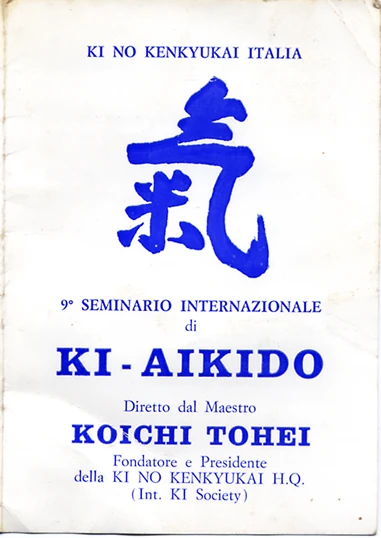
It's just a crumpled piece of folded cardboard. And yet it immediately brought back very vivid memories from 1987 (and it seems hard to believe that it was really that long ago!). In the summer of that year, some members of our Aikido Club from London decided to take a holiday in Italy along with our Sensei, David Currie. The reason for the visit was the Aikido seminar being given in Florence by no less than Koichi Tohei, 10th dan and formerly the chief instructor appointed by the founder (O Sensei). Tohei Sensei is now known as the founder of 'Ki Aikido'. Suffice to say, it was (quite literally) a once in a lifetime experience and I now realise how immensely privileged I was to have been a part of it. At any rate, I no longer regard this piece of crumpled cardboard as 'disposable'. From now on, I shall treasure it.
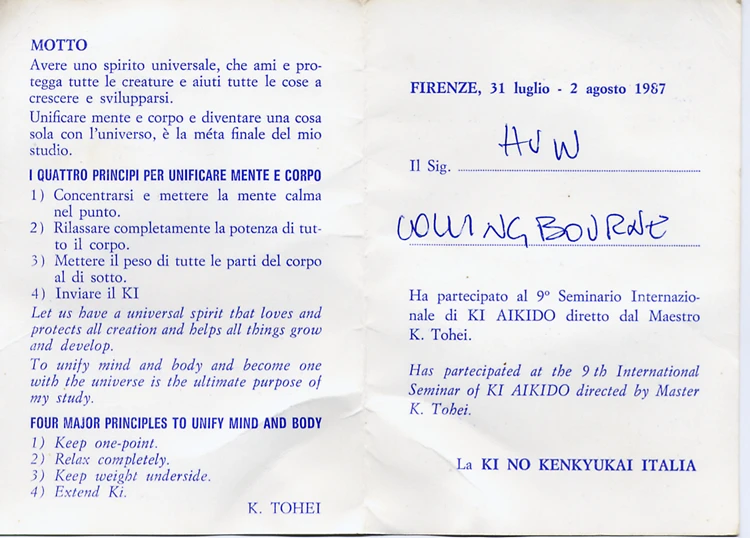
It's just a crumpled piece of folded cardboard. And yet it immediately brought back very vivid memories from 1987 (and it seems hard to believe that it was really that long ago!). In the summer of that year, some members of our Aikido Club from London decided to take a holiday in Italy along with our Sensei, David Currie. The reason for the visit was the Aikido seminar being given in Florence by no less than Koichi Tohei, 10th dan and formerly the chief instructor appointed by the founder (O Sensei). Tohei Sensei is now known as the founder of 'Ki Aikido'. Suffice to say, it was (quite literally) a once in a lifetime experience and I now realise how immensely privileged I was to have been a part of it. At any rate, I no longer regard this piece of crumpled cardboard as 'disposable'. From now on, I shall treasure it.
Wednesday, 30 May 2012
Ki in Aikido - what is it?
“Aikido” means “The way of harmonizing with Ki”. OK, fair enough. But what, exactly is Ki?
In different books on Aikido, you will find a number of different descriptions of Ki. In his book, The Spirit of Aikido, Kisshomaru Ueshiba (the founder’s son) describes Ki as “The world-forming energy which also lies at the core of each human being”. In Ki In Daily Life, Koichi Tohei (founder of Ki Aikido) describes ki as “the real substance of the universe”. In their classic text on Aikido, Aikido and The Dynamic Sphere, Adele Westbrook and Oscar Ratti describe ki as “inner energy” and they go on to state: “No ki – no Aikido.”
So, in short, what are we to make of this? Ki would seem to be some sort of energy that is both inside you and beyond you? And it is fundamental to Aikido. Which may make you wonder whether you need to be a physicist or a philosopher to understand ki. And, once you’ve understood it, you then have to find out how to use it in Aikido.
 If this is confusing, don’t panic! The good news is that you don’t need to study any esoteric arts to understand how to put the ki into aikido. For some people ki may have a spiritual or mystical dimension – and that’s fine. For other people, ki is no more than a convenient shorthand term for a way of thinking and acting that has more to do with psychology and physics than parapsychology and metaphysics – and that’s fine too.
In Ki Aikido we talk a great deal about “extending Ki”. I like the description that Koretoshu Maruyama gives in his book, Aikido With Ki: “To extend ki is to have a positive spirit.” In my view, the simplest explanations are often the best and this, it seems to me, is a perfect summary of ki extension – a positive spirit. When you go to embrace someone you love you naturally extend ki. You don’t have to think about how to do it; it just happens.
In Ki Aikido, we have an exercise called ‘unbendable arm’ in which we learn to extend an arm and, even though we keep the arm loose and relaxed, it is very hard for someone to use force to bend the arm at the elbow. Beginners may find this exercise very hard to master. They constantly want to use strength, and tension, to ‘fake’ unbendable arm. To explain the feeling we are looking for, I sometimes ask a student to walk towards me and shake my hand. Assuming they are happy to do that (if they found me intimidating, the exercise would be counter-productive!) they generally find that the mere action of shaking my hand automatically gives them unbendable arm. That’s because they are naturally extending a positive feeling; it is no longer a difficult ‘test’; it is something that is easy to do without making a conscious effort.
That is a fundamental feature of ki extension. It isn’t a clever martial art technique at all. It is something that everyone does naturally. The secret is to be able to put yourself into a frame of mind in which that positive feeling is natural all the time – even when you are practising Aikido at high speed. It’s not something you turn on and off – it’s just there.
When students first get the feeling for ‘extending ki’, they are often surprised at how easy and natural it is. Prior to getting that feeling they often assume that is something that is incredibly difficult to achieve and not at all natural. But even those of us who have practised Aikido for a long time may sometimes lose that feeling: we allow ourselves to become tense, to try to do something with force rather than with a positive spirit. That is one of the reasons for all the many Ki development exercises we practise in Ki Aikido. Sometimes “doing what comes naturally” can be surprisingly difficult!
In different books on Aikido, you will find a number of different descriptions of Ki. In his book, The Spirit of Aikido, Kisshomaru Ueshiba (the founder’s son) describes Ki as “The world-forming energy which also lies at the core of each human being”. In Ki In Daily Life, Koichi Tohei (founder of Ki Aikido) describes ki as “the real substance of the universe”. In their classic text on Aikido, Aikido and The Dynamic Sphere, Adele Westbrook and Oscar Ratti describe ki as “inner energy” and they go on to state: “No ki – no Aikido.”
So, in short, what are we to make of this? Ki would seem to be some sort of energy that is both inside you and beyond you? And it is fundamental to Aikido. Which may make you wonder whether you need to be a physicist or a philosopher to understand ki. And, once you’ve understood it, you then have to find out how to use it in Aikido.
In Ki Aikido we talk a great deal about “extending Ki”. I like the description that Koretoshu Maruyama gives in his book, Aikido With Ki: “To extend ki is to have a positive spirit.” In my view, the simplest explanations are often the best and this, it seems to me, is a perfect summary of ki extension – a positive spirit. When you go to embrace someone you love you naturally extend ki. You don’t have to think about how to do it; it just happens.
In Ki Aikido, we have an exercise called ‘unbendable arm’ in which we learn to extend an arm and, even though we keep the arm loose and relaxed, it is very hard for someone to use force to bend the arm at the elbow. Beginners may find this exercise very hard to master. They constantly want to use strength, and tension, to ‘fake’ unbendable arm. To explain the feeling we are looking for, I sometimes ask a student to walk towards me and shake my hand. Assuming they are happy to do that (if they found me intimidating, the exercise would be counter-productive!) they generally find that the mere action of shaking my hand automatically gives them unbendable arm. That’s because they are naturally extending a positive feeling; it is no longer a difficult ‘test’; it is something that is easy to do without making a conscious effort.
That is a fundamental feature of ki extension. It isn’t a clever martial art technique at all. It is something that everyone does naturally. The secret is to be able to put yourself into a frame of mind in which that positive feeling is natural all the time – even when you are practising Aikido at high speed. It’s not something you turn on and off – it’s just there.
When students first get the feeling for ‘extending ki’, they are often surprised at how easy and natural it is. Prior to getting that feeling they often assume that is something that is incredibly difficult to achieve and not at all natural. But even those of us who have practised Aikido for a long time may sometimes lose that feeling: we allow ourselves to become tense, to try to do something with force rather than with a positive spirit. That is one of the reasons for all the many Ki development exercises we practise in Ki Aikido. Sometimes “doing what comes naturally” can be surprisingly difficult!
Monday, 13 February 2012
What Is Aikido?
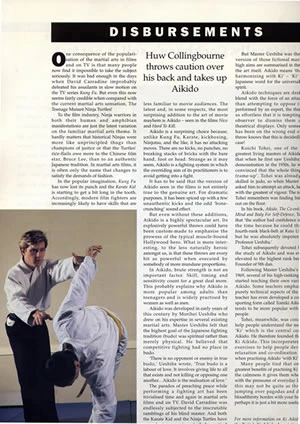
This is an edited version of an article which I wrote some years ago for ‘Legal Business’ magazine.
Strange as it may seem, Aikido is a fighting system in which the overriding aim of its practitioners is to avoid getting into a fight. Even so, Aikido is a highly spectacular martial art. Its explosively powerful throws could have been custom-made to emphasise the prowess of the typical muscle-bound Hollywood hero. What is more interesting, to the less naturally heroic amongst us, is that these throws are every bit as powerful when executed by somebody of more mundane proportions.
Aikido was developed in early years of this century by Morihei Ueshiba who drew on his expertise in several existing martial arts. Master Ueshiba felt that the highest goal of the Japanese fighting tradition (budo) was spiritual rather than merely physical. He believed that competitive fighting had no place in budo.
‘There is no opponent or enemy in true budo,’ Ueshiba wrote, ‘True budo is a labour of love. It involves giving life to all that exists and not killing or opposing one another... Aikido is the realisation of love.’
The paradox of preaching peace while performing a fighting art has been trivialised time and again in martial arts films and on TV. David Carradine was endlessly subjected to the inscrutable ramblings of his blind master in the old TV Kung Fu series. And both the Karate Kid and the Ninja Turtles have peace-loving sages in a similarly mystical tradition. But Master Ueshiba was the real-life version of those fictional masters. His high aims are summarised in the name of the art itself. Aikido means ‘the way of harmonising with Ki’ — ‘Ki’ being a Japanese word for the universal creative spirit.
Aikido techniques are designed to blend with the force of an attack rather than attempting to oppose it. When performed by an expert, the throws look so effortless that it is tempting for the observer to dismiss them as mere theatrical displays. Only someone who has been on the wrong end of such a throw knows that this is decidedly not the case!
The late Koichi Tohei, one of the greatest masters of Aikido, recalled that when he first saw Ueshiba doing a demonstration in the 1930s, he was quite convinced that the whole thing was ‘a frame-up’. Tohei was already highly skilled in judo, so when Master Ueshiba asked him to attempt an attack, he obliged with the greatest of vigour. The next thing Tohei remembers was finding himself flat out on the floor.
In his book, Aikido, The Co-ordination of Mind and Body For Self-Defence, Tohei says that ‘the author had confidence in Judo at the time because he could throw any fourth-rank black-belt at Keio University, but he was absolutely impotent against Professor Ueshiba.’ Tohei subsequently devoted his life to the study of Aikido.
Following Master Ueshiba’s death in 1969, several of his high-ranking students started teaching their own variations of Aikido. Some teachers emphasised the purely technical aspects of the art. One teacher has even developed a competitive sporting form called Tomiki Aikido which tends to be more popular with younger people.
Tohei, meanwhile, was concerned to help people understand the meaning of ‘Ki’ which is the central concern of Aikido. He therefore founded the style of Ki Aikido, which is the style practised at the Hartland Aikido Club. Ki Aikido incorporates various exercises to help people develop the relaxation and co-ordination required when practising Aikido ‘with Ki’.
Many people find that one of the greatest benefits of practising Ki Aikido is the calmness it gives them when coping with the pressures of everyday life. While this may not be quite as thrilling as jumping over pagodas and defeating bloodthirsty hordes with your bare hands, perhaps it is, for most people most of the time. just a bit more useful.
Subscribe to:
Posts (Atom)